ACT landscaping services and maintenance covers the full outdoor project: site analysis and design, earthmoving and excavation, retaining walls, drainage, turf and planting, then ongoing garden care. In Canberra, the work is shaped by clay soils, frosty winters and dry summers, so preparation and plant selection matter as much as the design itself.
Key Takeaways
- A Canberra landscape project runs in stages — design, earthworks and drainage, structure, planting, then maintenance — and skipping the early stages is what causes most later failures.
- Clay soil and poor drainage are the two conditions that most often dictate what a Canberra garden can support.
- Frost-tolerant and drought-resistant planting suits the local climate, where summers are dry and winters bring regular frosts.
- Retaining walls, turf, irrigation and drainage are structural decisions, not finishing touches — they are set at the earthworks stage.
- Ongoing garden maintenance protects the investment; established and new-estate blocks need different care.
- Act House & Landscaping Maintenance is a family-owned Canberra team working across Canberra Central, Belconnen, Gungahlin, Woden Valley and Tuggeranong.
Transforming an outdoor space in the Australian Capital Territory takes local knowledge as much as design flair. From the established streets of Canberra Central to the newer estates in Belconnen and Gungahlin, good ACT landscaping services and maintenance is about creating functional, durable spaces that survive the region’s climate — not just gardens that photograph well in their first spring.
Act House & Landscaping Maintenance works across Canberra and the surrounding region, on everything from a full garden overhaul to earthmoving, drainage and regular garden care. Every property is different: a compact block in Braddon and a large family yard in Tuggeranong start from different soil, different aspect and different expectations.
Landscape Design for Canberra Conditions
Design is where a project either accounts for its site or ignores it. A design that works elsewhere in Australia will not necessarily hold up through a Canberra winter, so the plan has to start with what the block actually is.
Site Analysis Comes First
The process begins with a site visit and consultation — discussing ideas, preferences and budget, then assessing what is already there. That means soil type (clay is common across much of Canberra), drainage patterns, existing vegetation, sun and wind exposure, and the style of the house. It is the least visible stage of a landscaping project and the one that most influences whether the finished garden performs.
Turning the Site Into a Plan
From that analysis comes the design itself: levels, material selections, where retaining walls sit, where water goes, and a planting plan matched to the aspect. Getting the sequence right matters — retaining walls, drainage and irrigation are decided before turf and planting, because they cannot be sensibly retrofitted afterwards. If you want to see how this translates into a specific brief and figure, our guide to a custom landscaping design and quote in Canberra walks through what a proper quote should cover.
Climate-Appropriate Planting
Canberra’s hot, dry summers and frosty winters narrow the plant list considerably. Drought-resistant and frost-tolerant species — including many local natives — hold up far better than the alternatives, and thoughtful placement can provide summer shade while letting winter sun through. On established blocks the existing mature trees usually set the framework, and the design works around them rather than against them; our notes on garden renovation for established Canberra Central homes cover that balance in more detail. Where a property sits inside a heritage area, designs also have to respect the existing character and the applicable local guidelines.
Earthmoving, Excavation and Site Preparation
Most landscaping problems in Canberra are groundwork problems. Levels that were never corrected, fill that was never compacted, and water that was never given anywhere to go all show up later as slumping turf, cracked surfaces or a lawn that stays wet through winter.
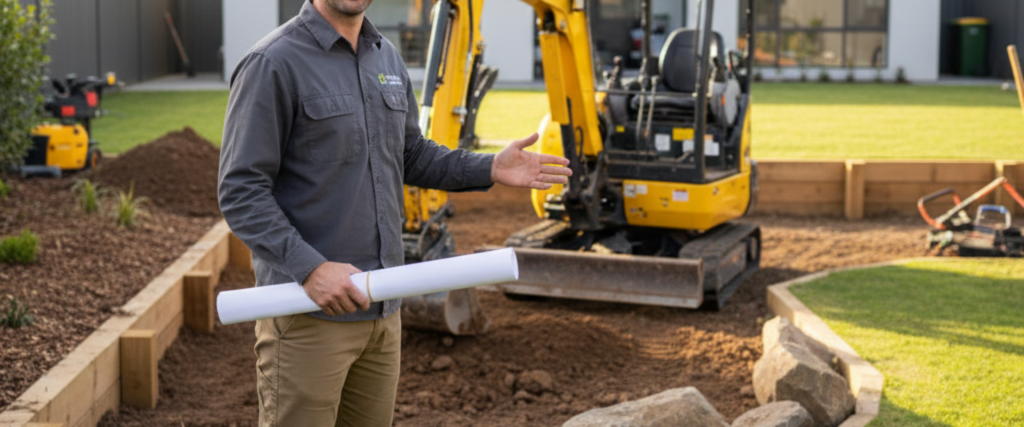
Earthmoving and excavation work handles the levels, the cut and fill, trenching for services and drainage, and the removal of spoil and debris. On tight suburban blocks a bobcat or mini digger does the work that would otherwise take days by hand, and the machine choice is dictated by access as much as by the volume of material. For a new build starting from a bare block, this is effectively the whole first phase of the landscape — our bare-block landscaping checklist for new builds sets out the order that work usually runs in.
Drainage and Clay Soil
Clay holds water. On a sloping block that means run-off ends up somewhere it was not intended, and on a flat one it means it sits. Either way, drainage is a design decision rather than a repair job — surface falls, subsurface drainage and the way garden beds and lawn areas are built up all determine where water ends up.
Retaining walls do double duty here: they hold the ground, and if they are built with proper backfill and drainage behind them, they manage water as well. A wall built without that provision is a wall under hydrostatic pressure, which is why so many older ones eventually lean. Homeowners dealing with these conditions in the north of Canberra may find our piece on drainage and clay soil in Belconnen useful background.
Turf, Irrigation and Planting
Turf succeeds or fails on what is underneath it. Proper preparation — correct levels, adequate soil depth, and drainage that actually works — matters more than the variety chosen. Irrigation planned at the same time saves water and reduces the amount of hand-watering a garden needs through a dry Canberra summer, and it is far simpler to install before turf goes down than after.
Ongoing Garden Maintenance
A completed landscape is the start of the maintenance cycle, not the end of it. Regular garden care — mowing, pruning, weed control, mulching, seasonal clean-ups and green waste removal — keeps a garden looking the way it was designed to and catches small problems while they are still small. The work changes through the year: autumn clean-ups, winter pruning and frost protection, spring feeding and summer watering all sit at different points in the calendar, as our seasonal garden maintenance guide sets out.
Alongside the garden, house and roof maintenance keeps the rest of the property in order — gutter cleaning, roof repairs, re-bedding and re-pointing, and general repairs. Blocked gutters and poor roof drainage are, in practice, a landscaping problem too: water that cannot leave the roof properly ends up in the garden beds beside the house.
Working Across Canberra’s Districts
Each part of Canberra presents a different starting point. Established suburbs in Canberra Central and the older parts of Woden Valley and Belconnen tend to have mature trees, settled soil and existing structures that are approaching the end of their life. Newer estates in Gungahlin and the outer growth areas usually start from a bare, compacted block with builder’s fill and no established drainage at all. Both need the same disciplined sequence of work — they simply enter it at different points.
Frequently Asked Questions
Act House & Landscaping Maintenance is a family-owned Canberra team with more than 20 years’ experience, fully insured, working on landscaping, gardening, earthmoving and excavation, retaining walls, drainage, turf and irrigation, rubbish removal, and house and roof maintenance across the ACT.
Talk to a Canberra Landscaping Team
If you are planning a garden overhaul, need earthworks and drainage sorted before anything else goes in, or simply want reliable ongoing garden maintenance, call 0406 700 400 to discuss the site. You can also request a quote or email [email protected], and we will arrange a time to look at the property.