
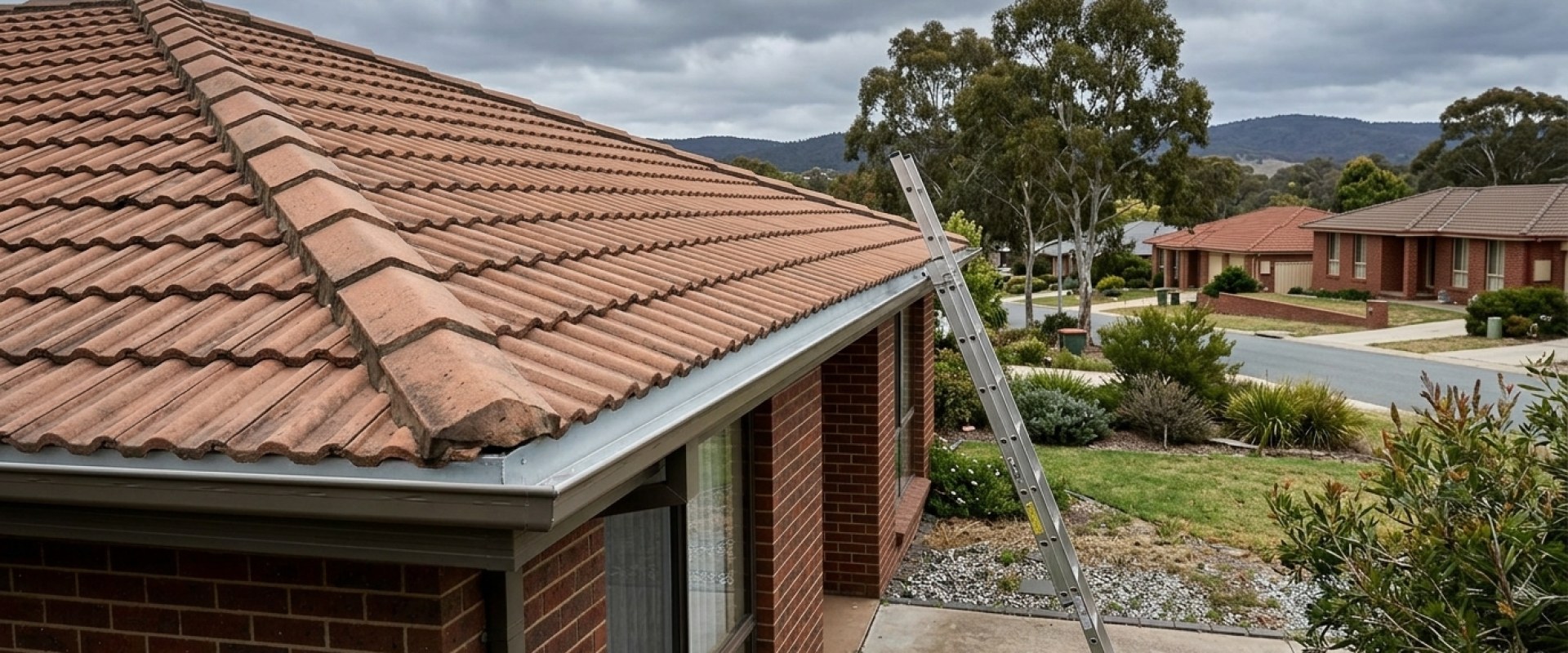
Gutters clogged with autumn leaves and loose tiles rattling in a Canberra southerly are two of the most common calls we get from homeowners in Greenway, ACT, Tuggeranong before a change of season. Clearing gutters and checking the roof for lifted or cracked tiles before heavy rain or wind arrives is one of the most effective ways to stop water finding its way into ceilings, walls and foundations. This guide to roof maintenance Greenway homeowners can plan sets out what to check, why it matters for Greenway’s exposure to sudden storms and frost, and when it’s time to call in a professional rather than getting up on the roof yourself.
Greenway sits within Tuggeranong, an area that gets its share of Canberra’s dry summers followed by sudden, heavy downpours. That swing between dry and wet conditions is exactly what puts pressure on ageing roofs and neglected guttering. When gutters are full of leaf litter and debris, water has nowhere to go but over the edge, down the fascia, and into the eaves. The roof maintenance Greenway homes need is less about a one-off job and more about a seasonal rhythm — checking, clearing and repairing before the weather forces the issue.
A roof doesn’t need to be old to fail. A single dislodged tile, a cracked ridge cap or a sagging gutter bracket can be enough to let water track into the roof cavity. Left unchecked, that moisture can damage insulation, ceiling linings and timber framing well before any leak becomes visible from inside the house.
Gutter cleaning is part of the roof maintenance Greenway homes need, but a proper pre-season clean covers more than scooping out leaves. It means checking that gutters are pitched correctly so water actually flows to the downpipe, that brackets are still holding the gutter firmly to the fascia, and that downpipes themselves aren’t blocked further down the line. A gutter that looks clear at the opening can still be backing up if the downpipe below it is choked with compacted debris. Guidance on gutter cleaning services in Tuggeranong, ACT sets this out in more detail.
For homeowners doing a visual check themselves, look for sagging sections, rust spots, and water stains on the fascia board underneath the gutter line — all signs that water has already been overflowing. If you’re due for a broader look at what else around the property needs attention before the season turns, our custom house maintenance checklist for Canberra homeowners covers the wider seasonal picture beyond just the roof.
If you’re weighing up whether to call someone in now or wait, our team is available to talk through the roof maintenance Greenway properties need before the weather turns — call 0406 700 400 or email [email protected] to arrange a look at your roof and gutters.
Tiles move over time — thermal expansion, wind uplift and general age all play a part. A walk around the perimeter of the house with binoculars, rather than climbing onto the roof, is usually enough to spot tiles that have slipped out of line, cracked, or lost their nib. Ridge capping and flashings around chimneys, vents and valleys are worth particular attention, since these junction points are where most roof leaks actually start rather than in the open field of tiles.
Repointing and rebedding of ridge caps is part of the roof maintenance Greenway homeowners may need on older tiled roofs, where the mortar bedding has dried out and cracked over years of sun exposure. This isn’t a cosmetic fix — it’s what keeps ridge tiles physically secured and weatherproof.
A blocked gutter doesn’t wait for a warning sign; the first sign is usually water where it shouldn’t be.
The roof maintenance Greenway homeowners arrange is closely connected to drainage. Once water leaves a downpipe, where it goes next matters just as much as whether the gutter was clear in the first place. Downpipes that discharge onto saturated ground, poorly graded soil, or blocked stormwater connections can push water straight back toward the foundations. If you’ve noticed pooling near the base of downpipes or damp patches along external walls after rain, it’s worth looking at the broader site drainage rather than treating it as a roofing-only issue — our page on drainage excavation services in Canberra covers how grading and excavation work together to move water away from a house properly.
Some signs point to a problem that’s already progressed past the routine roof maintenance Greenway homes need. Water stains spreading across a ceiling, a musty smell in a roof cavity, sagging gutters pulling away from the fascia, or tiles you can see are visibly out of alignment from the ground are all reasons to get a proper inspection rather than leaving it until the next dry spell. Roofing issues rarely improve on their own — a small gap in a ridge cap or a cracked tile tends to widen with every freeze-thaw cycle and every storm that follows.
Getting up on a tiled roof without the right footing and equipment is also a genuine safety risk, particularly on steeper pitches or older tiles that can crack further under foot traffic. This is one area of home maintenance where a professional check is worth it even if the problem turns out to be minor.
The roof maintenance Greenway homeowners plan works best as part of a broader maintenance routine rather than a one-off reaction to a leak. Pairing a seasonal roof check with the rest of your property’s upkeep — garden drainage, retaining walls, general house maintenance — means problems get caught while they’re still small and cheap to fix. For Greenway homeowners managing an established property, treating the roof as one part of a whole-property maintenance plan tends to save both money and stress over the years.
As part of roof maintenance Greenway homeowners plan, gutters generally need attention at least once before the wetter part of the year and again after any period of heavy leaf drop nearby. Properties with overhanging trees may need more frequent checks. Get in touch to discuss what’s appropriate for your specific property.
Ceiling stains, peeling paint on ceilings or walls, a musty smell in a roof cavity, and damp patches appearing after rain are the most common early indicators. By the time a leak is visible inside, water has often been getting in for some time.
Yes. Ridge capping and the mortar bedding beneath it are a common entry point for water, since they sit at a junction rather than a flat, continuous surface. Cracked or lifted ridge tiles allow water to track underneath during rain and wind.
It can. Overflowing gutters direct water down external walls and toward the foundations rather than away from the house through the stormwater system, which is why the roof maintenance Greenway homeowners arrange and site drainage are often looked at together.
A ground-level visual check with binoculars is one part of roof maintenance Greenway homeowners can handle themselves to spot obvious issues. Climbing onto a tiled roof without the right equipment carries real fall and tile-damage risk, so anything beyond a visual check is best left to someone experienced with the work.
The roof maintenance Greenway homes need before winter typically covers clearing gutters and downpipes, checking for loose or cracked tiles, inspecting ridge capping and flashings around chimneys and vents, and confirming that water is draining away from the house rather than pooling near the foundations.
The roof maintenance Greenway homes need rarely feels urgent until the day it rains hard and something gives way. For Greenway homeowners, the practical move is to treat gutter clearing and tile checks as a standing seasonal task rather than something to think about only after water has already found its way inside.
A house that’s had its gutters cleared, its tiles checked and its drainage looked at together is in a far stronger position heading into a wet spell than one that’s only ever reacted to a visible leak.
If it’s been a while since your roof and gutters were properly checked, now is a sensible time to arrange it before the next round of Canberra weather arrives.
To book a roof and gutter check as part of the roof maintenance Greenway homes need, call 0406 700 400 or email [email protected].
We use cookies to understand how this site is used and to improve it. Privacy policy